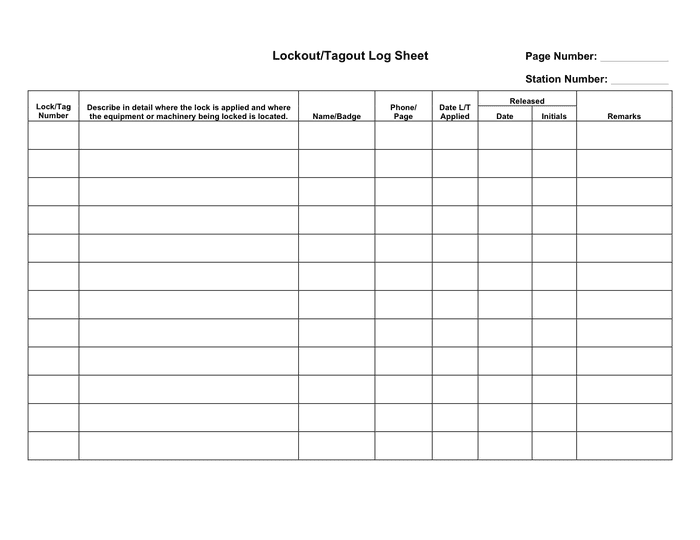
Every year, hundreds of workers suffer serious injuries—or worse—due to unexpected equipment startup during maintenance. The root cause? Inconsistent or missing lockout tagout (LOTO) procedures. OSHA’s standard 29 CFR 1910.147 exists to prevent these tragedies, mandating strict energy control protocols. But knowing the rule isn’t enough. You need a reliable, customizable OSHA lockout tagout procedure template that turns compliance into action.
A well-structured LOTO template doesn’t just satisfy regulators—it protects lives, reduces downtime, and builds a culture of accountability. This guide delivers a practical, ready-to-adapt template along with implementation essentials, common pitfalls, and real-use insights for safety managers, operations leads, and maintenance teams.
Why a Standardized LOTO Template Is Non-Negotiable
Without a documented lockout tagout procedure, even the most seasoned technician can make a fatal error. Assumptions replace verification. Shortcuts become routine. Energy sources get overlooked.
A standardized template removes ambiguity. It turns OSHA’s broad requirements into step-by-step instructions tailored to specific machines. Consider this scenario: a conveyor belt system in a food processing plant has multiple energy sources—electrical, pneumatic, and gravity-fed components. A generic “turn it off” approach won’t suffice. A detailed LOTO template identifies each isolation point, specifies lock types, and lists authorized personnel.
More importantly, a template ensures consistency across shifts, reduces training time, and provides audit-ready documentation. OSHA doesn’t require a universal form, but it does require written procedures for each machine or equipment group. Failure to document is a common citation—and a preventable one.
Core Elements of an OSHA-Compliant LOTO Procedure Template
Your template must meet OSHA’s seven key criteria under 1910.147(c)(4). These aren’t suggestions—they’re legal requirements. Here’s how to embed them into your document:
#### 1. Machine or Equipment Identification Clearly name the equipment, including model, serial number, and location. Use unique identifiers to avoid confusion—especially in facilities with multiple identical units.
Example: “Hydraulic Press #3 – West Assembly Line, Bay 7”
#### 2. Energy Source Inventory List every potential energy source: electrical, mechanical, hydraulic, pneumatic, chemical, thermal, and gravitational. Be specific.
Example: - 480V 3-phase electrical supply - Pneumatic lines (120 PSI) - Hydraulic accumulator (3,000 PSI) - Gravity feed from overhead bin
#### 3. Shutdown Steps Provide clear, sequential instructions for normal shutdown. Use imperative language.
- Example:
- Press “E-Stop” at control panel.
- Rotate mode selector to “Off.”
- Wait for all moving parts to stop (verify visually).
#### 4. Isolation and Lock Application Detail every energy-isolating device and the method to secure it.
Example: - Open circuit breaker #P3-22 in Panel B. Apply lockout hasp and personal lock. - Close pneumatic shutoff valve at supply line. Tag and lock in “Closed” position. - Depressurize hydraulic system via manual bleed valve. Confirm 0 PSI.
#### 5. Stored Energy Release Specify how to safely dissipate or block residual energy.
Example: - Engage mechanical lock on press ram to prevent descent. - Drain hydraulic lines using bleed port. Verify with pressure gauge. - Block conveyor rollers with locking pins.
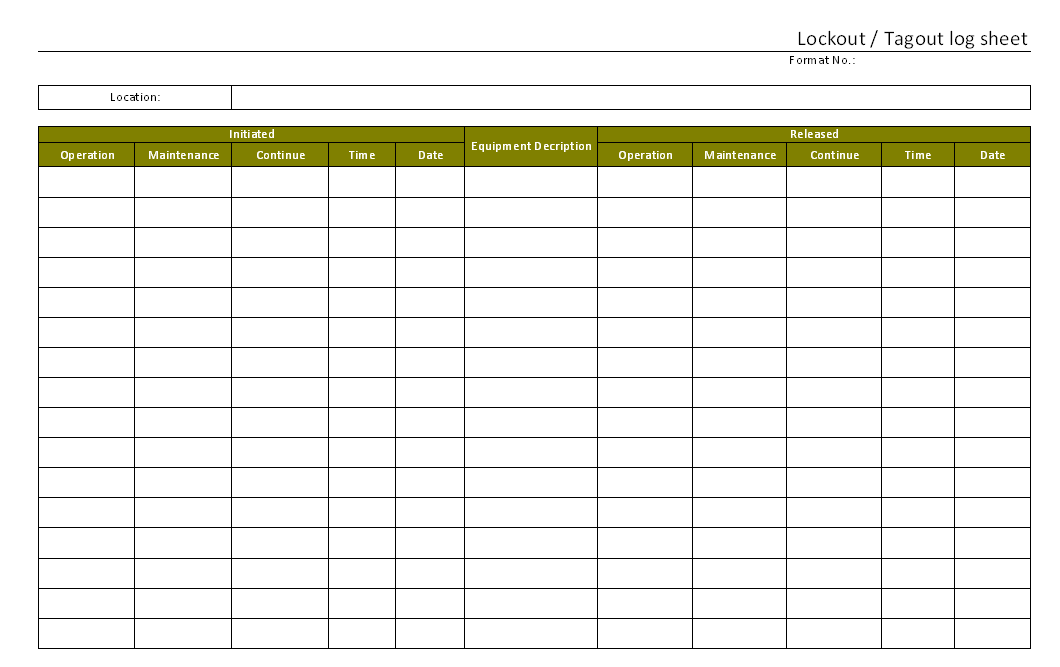
#### 6. Verification of Isolation This is the most frequently overlooked step. The template must require positive confirmation that zero energy exists.
Example: - Attempt to start machine using control panel (ensure no response). - Test electrical panel with voltage tester. - Visually confirm no movement or pressure.
#### 7. Removal and Re-energization Outline the safe process for clearing the area, removing locks, and restarting.
- Example:
- Confirm all tools are removed and guards reinstalled.
- Notify all affected employees that operation will resume.
- Remove personal locks only—each employee removes their own.
- Restore energy sources in reverse order of shutdown.
Real-World LOTO Template Example: CNC Lathe
Below is a condensed version of a compliant procedure you can adapt:
Equipment: CNC Lathe Model XL-2000 – Machining Cell 4 Authorized Employees: Only certified maintenance technicians (MT-01 to MT-12)
Energy Sources: - 208V electrical (Motor Control Center Panel #4) - Compressed air (80 PSI supply line) - Rotational inertia (spindle and chuck)
- Steps:
- Press “Cycle Stop” and allow spindle to halt completely.
- Rotate key switch to “OFF” and remove key.
- Open disconnect switch in MCC Panel #4. Apply personal lock and tag.
- Close air shutoff valve near machine base. Lock in “Closed” position.
- Engage chuck brake and secure with locking pin.
- Attempt to start machine—verify no response.
- Confirm spindle is at 0 RPM and air gauge reads 0 PSI.
- Begin servicing.
- After service: Clear area, remove tools, reinstall guards.
- Notify operator, remove locks, restore power and air.
- Return key switch to “Run” mode.
This structure is repeatable across equipment types and scalable across facilities.
Common Template Mistakes That Trigger OSHA Violations
Even with a template, companies fail audits due to preventable errors. Here are the top five missteps:
1. Using a One-Size-Fits-All Approach A single generic form for all machines violates OSHA. Each piece of equipment must have a unique procedure matching its energy profile.
2. Skipping Stored Energy Many templates list isolation steps but omit how to neutralize stored energy. This is a frequent root cause of incidents.
3. Vague Language Phrases like “turn off power” or “secure machine” are insufficient. OSHA requires specificity: which disconnect, how it’s locked, what tools verify isolation.
4. No Verification Step If the template doesn’t mandate a tryout test, it’s non-compliant. Verification isn’t optional.
5. Outdated or Unapproved Documents Templates must be reviewed annually and updated when equipment changes. Uncontrolled copies floating in the field create liability.
Customizing Your LOTO Template for Maximum Usability
A template is only effective if people use it correctly. Enhance adoption with these practical upgrades:
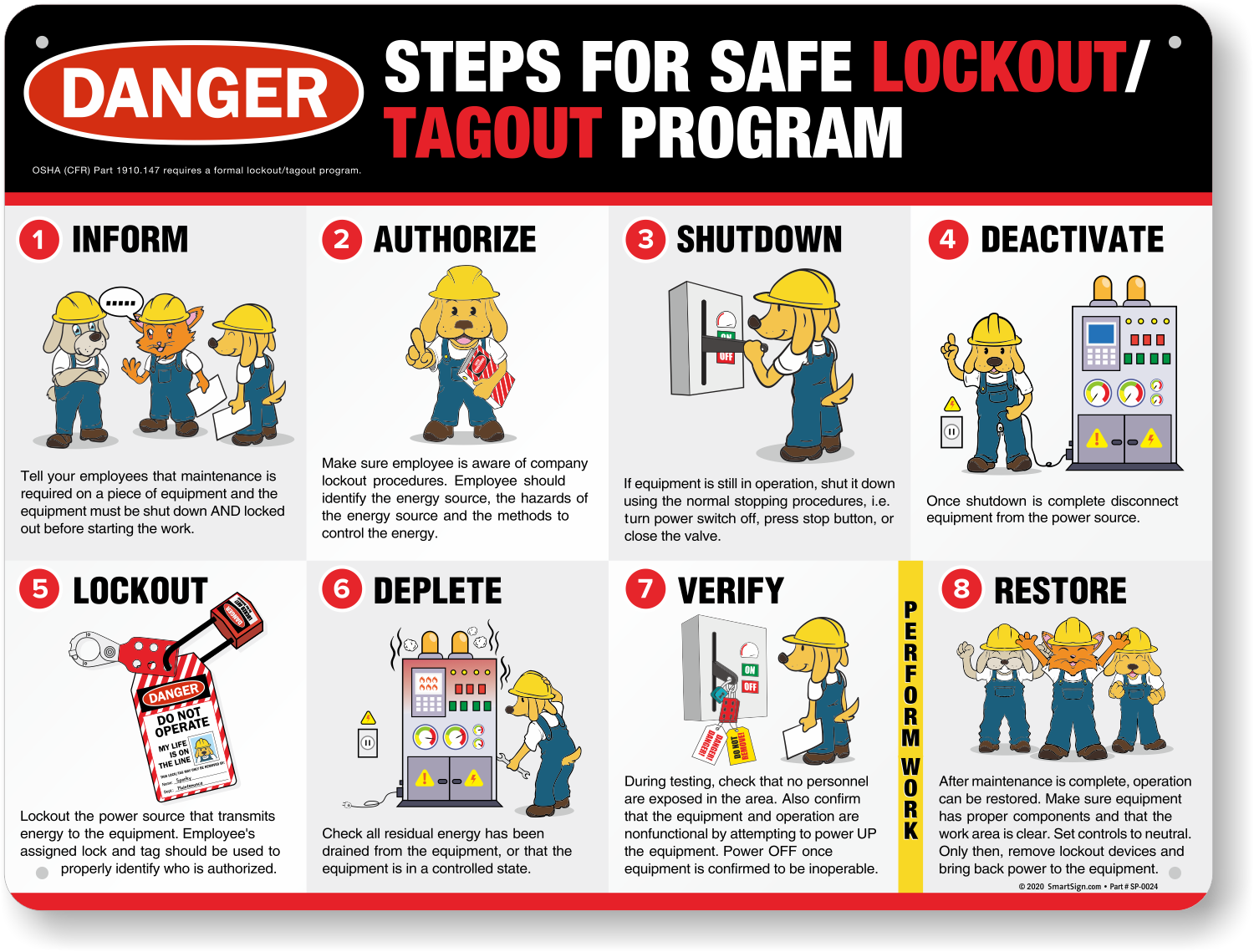
- Visual Aids: Include diagrams showing isolation points, lock locations, and energy flow. A photo of the disconnect with a red arrow helps prevent misidentification.
- QR Codes: Link physical equipment tags to digital procedures stored in your EHS software.
- Multilingual Support: In diverse workplaces, provide translated versions of key steps.
- Checklist Format: Convert procedures into tick-box checklists for field use. Technicians sign and date after each step.
- Integration with Training: Embed the template into onboarding and annual refreshers. Use it during LOTO drills.
One manufacturing plant reduced LOTO errors by 70% after switching from text-heavy manuals to laminated, illustrated checklists mounted near each machine.
Digital vs. Paper-Based LOTO Templates: What Works Best?
While OSHA accepts paper, digital systems are gaining traction for scalability and traceability.
| Factor | Paper Templates | Digital Templates |
|---|---|---|
| Accessibility | On-site only; prone to damage | Cloud-based; accessible via tablets |
| Version Control | Hard to manage; outdated copies common | Automatic updates; audit trail |
| Compliance Tracking | Manual sign-offs; hard to audit | Electronic logs; real-time reporting |
| Training Integration | Limited | Embedded videos, quizzes, alerts |
| Initial Cost | Low | Higher (software + devices) |
Digital tools like EHS platforms (e.g., Procore, SafetyCulture) let you standardize templates, assign locks, and generate compliance reports. However, they require internet access and device management. For smaller operations, a well-organized binder with color-coded procedures may suffice—provided it’s maintained.
Actionable Steps to Implement Your LOTO Template Today
Don’t wait for an incident or audit to act. Follow this workflow:
- Inventory Equipment
- List every machine requiring LOTO. Prioritize high-risk or complex systems.
- Conduct Energy Source Assessments
- For each, document all energy types and isolation points.
- Draft Custom Procedures
- Use the core elements above. Involve maintenance staff—they know the machines best.
- Review and Approve
- Have safety officers and operations leads sign off.
- Train and Certify
- Conduct hands-on LOTO training. Document attendance and competency.
- Audit Quarterly
- Observe lockout procedures in real time. Correct deviations immediately.
- Update Annually
- Reassess procedures every 12 months or after equipment modifications.
A strong OSHA lockout tagout procedure template isn’t paperwork—it’s a lifeline. It transforms regulatory language into actionable safety, ensuring every technician can service equipment without fear of sudden startup. Build your template with precision, customize it with care, and enforce it with consistency. Lives depend on it.
Frequently Asked Questions
What must be included in an OSHA lockout tagout procedure? It must identify the equipment, list all energy sources, outline shutdown and isolation steps, detail stored energy release, verify zero energy, and define re-energization protocol.
Can I use the same LOTO template for multiple machines? Only if they are identical in operation and energy profile. Otherwise, each machine needs a unique procedure.
Who can create a LOTO procedure template? Typically, safety managers, maintenance supervisors, or qualified personnel familiar with the equipment and OSHA standards.
Do tagout-only procedures meet OSHA requirements? Only in limited cases where energy isolation cannot be achieved with a lock. Tags alone are less secure and require additional safety measures.
How often should LOTO procedures be reviewed? OSHA requires annual inspections. Procedures should also be updated after equipment changes or incidents.
Can digital LOTO templates be OSHA-compliant? Yes, as long as they contain all required elements and are accessible to authorized employees during servicing.
Is employee training required for each LOTO procedure? Yes. Each authorized employee must be trained on the specific procedures for the equipment they service.
FAQ
What should you look for in OSHA Lockout Tagout Procedure Template Guide? Focus on relevance, practical value, and how well the solution matches real user intent.
Is OSHA Lockout Tagout Procedure Template Guide suitable for beginners? That depends on the workflow, but a clear step-by-step approach usually makes it easier to start.
How do you compare options around OSHA Lockout Tagout Procedure Template Guide? Compare features, trust signals, limitations, pricing, and ease of implementation.
What mistakes should you avoid? Avoid generic choices, weak validation, and decisions based only on marketing claims.
What is the next best step? Shortlist the most relevant options, validate them quickly, and refine from real-world results.